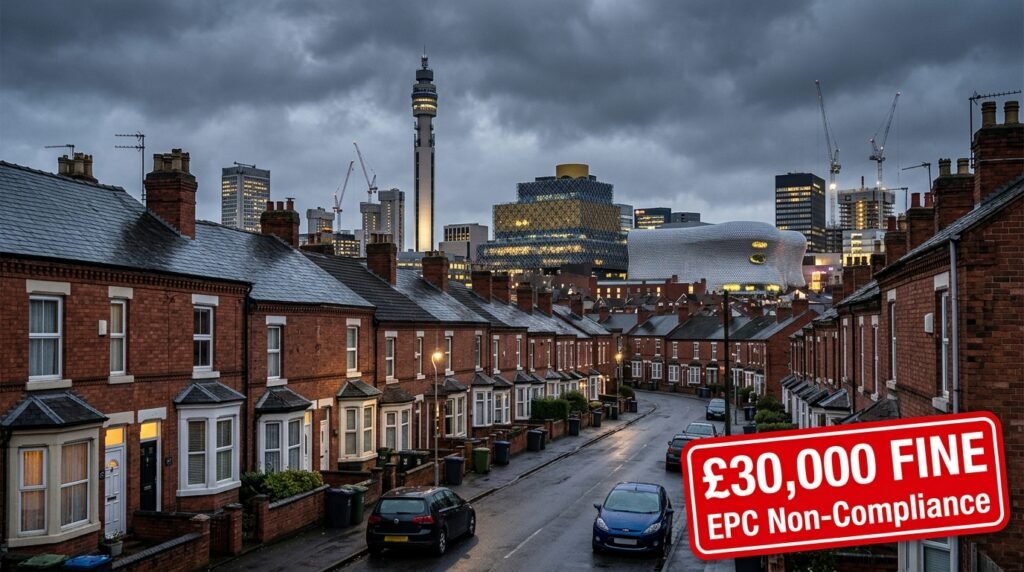
If you own a rental property in Birmingham, the financial stakes just got significantly higher. Under the UK government’s Warm Homes Plan — published on 21 January 2026 — the fine for EPC non-compliance has risen to up to £30,000 per property. That is a sixfold increase from the previous £5,000 maximum. Combined with a confirmed EPC C minimum standard by 2030 and a new compliance database that will allow councils to automatically flag non-compliant landlords, the era of ignoring energy certificates is over. In this guide, The Prime EPC breaks down exactly what has changed, what it means for your Birmingham property, and why waiting is the most expensive option of all.
The January 2026 Wake-Up Call: What the Warm Homes Plan Confirms
On 21 January 2026, the UK government published its long-awaited Warm Homes Plan — a 152-page document that locks in the biggest overhaul of private rental EPC rules in over a decade. For Birmingham landlords, these are the changes that directly affect your wallet and your legal standing:
| What is Changing | Key Detail | Date |
|---|---|---|
| Maximum fine per property | Rises from £5,000 to up to £30,000 | From 2030 |
| New minimum EPC standard | All private rentals must reach EPC band C | 1 October 2030 |
| New PRS compliance database | Landlords must register all properties — auto cross-referenced with EPC register | From late 2026 |
| New EPC assessment system (HEM) | Home Energy Model replaces current methodology | From late 2026 |
| Cost cap per property | Maximum required improvement spend: £10,000 | From Oct 2025 |
| Qualifying spend start date | Improvements from 1 Oct 2025 count towards the cap | Now |
Warning: According to government data, 52% of private rented properties in England and Wales are currently rated below EPC C — the majority of Birmingham landlords will need to act before 2030 to avoid fines.
The £30,000 Fine: What Exactly Triggers It?
This is the question every Birmingham landlord needs to understand. The new £30,000 penalty is not just for letting a non-compliant property — it applies across a wider range of breaches than many landlords realise. Under the government’s January 2026 proposals, local authorities can issue fines of up to £30,000 per property for any of the following:
- Letting a property that does not meet the minimum EPC standard without a valid, registered exemption
- Failing to comply with a compliance notice issued by your local council
- Registering false or misleading information on the exemptions register
- Failing to register your property on the new Private Rented Sector (PRS) Database, expected from late 2026
That last point is new — and it is critical. The PRS Database will require Birmingham landlords to register themselves and every property they let. Councils will then be able to automatically cross-reference this database against the national EPC register, flagging non-compliant properties without a landlord ever being reported by a tenant. This is a significant expansion of enforcement capability that removes the safety net many landlords have relied on.
For a Birmingham landlord with a portfolio of just five properties, total exposure from non-compliance could reach £150,000 in fines alone — before any remediation costs are added.
Birmingham’s Specific Challenge: Older Housing Stock
Birmingham faces a particular compliance challenge that makes acting early even more important. The city has an extensive stock of Victorian and Edwardian terraced properties — especially across areas such as Handsworth, Sparkbrook, Moseley, and Balsall Heath — many of which rely on older heating systems and lack modern insulation.
These are precisely the property types most likely to be sitting at EPC D or E today, and the most expensive to upgrade. Research shows that properties in Birmingham upgraded from an E to a C rating can see rental yields improve from approximately 5.5% to 6.2% — meaning the cost of improvements is not simply a compliance expense, but a direct investment in your property’s financial performance.
The government’s own figures estimate the average cost to bring a property up to EPC C at £5,400 — well within the £10,000 cost cap. But for properties with solid walls, older heating systems, or poor glazing, costs will be higher. That is precisely why starting now, rather than in 2029, is the only financially sensible strategy.
The New Compliance Database: There Is Nowhere to Hide
Under the previous enforcement regime, EPC non-compliance was largely complaint-driven. Councils typically acted only when a tenant or third party raised an issue. That is about to change fundamentally.
The new Private Rented Sector (PRS) Database, rolling out from late 2026, will require every Birmingham landlord to register their rental properties. This database will be automatically cross-referenced with the national EPC register — allowing councils to identify non-compliant properties at scale, without waiting for any complaint.
Local authorities will also have expanded powers to issue compliance notices requesting up-to-date EPCs, tenancy agreements, and documented evidence of any energy improvements made. Enforcement will prioritise properties most likely to expose tenants to fuel poverty — meaning lower-rated properties in Birmingham’s private rental hotspots will be scrutinised first and fastest.
What Are the Rules Today — and What Changes in 2030?
Understanding the distinction between today’s rules and the 2030 requirements is essential for planning your compliance timeline correctly:
| Period | Minimum EPC Standard | Maximum Fine |
|---|---|---|
| Now (2026) | Band E — F and G rated properties cannot legally be let | Up to £5,000 (current law) |
| From 1 October 2030 | Band C equivalent — D, E, F and G rated properties must be upgraded | Up to £30,000 (confirmed Jan 2026) |
This means that if your Birmingham property is currently rated D or E, it is legally lettable today — but it will not be from October 2030. You have under four years to plan, fund, and complete upgrades. With contractor availability expected to tighten significantly from 2027 onwards as the deadline approaches, that window is considerably narrower than it appears.
The £10,000 Cost Cap: How to Use It to Your Advantage
The government’s £10,000 cost cap is frequently misunderstood by landlords. It is not a grant — it is the maximum amount you are legally required to spend on improvements in pursuit of compliance. Here is how it works in practice:
- You must spend up to £10,000 per property on qualifying energy efficiency improvements to reach EPC C.
- All spending from 1 October 2025 already counts — any improvements made or commissioned from that date reduce your remaining cap obligation.
- If a property cannot reach C after £10,000 of improvements, you may register a cost cap exemption — but all reasonable measures must be documented and demonstrably attempted first.
- For properties valued below £100,000, an alternative cap applies: 10% of the property’s value, which may be significantly lower than £10,000.
- A six-month grace period exemption is available if you have recently taken over a property with an existing tenancy already in place.
Smart move: A Birmingham landlord who spends £3,000 on insulation this year and £2,500 on heating controls next year has already reduced their remaining compliance obligation to just £4,500 by 2028 — spreading the cost entirely on their own terms, before contractor rates rise.
The Hidden Deadline: Why October 2029 Matters More Than 2030
Alongside the minimum standard changes, the government is introducing a completely new EPC assessment system — the Home Energy Model (HEM) — which replaces the current Energy Efficiency Rating (EER) methodology.
The HEM launches in late 2026 and runs alongside the current system until 1 October 2029, after which all new EPCs must use HEM. The new system is expected to be harder to achieve a C rating under, particularly for properties dependent on gas heating. This creates a critical hidden deadline within the 2030 deadline.
Birmingham landlords who achieve EPC C under the current system before 1 October 2029 will be protected under the government’s “grandparenting” provision — their property will be treated as compliant until that EPC expires. Those who miss this window face reassessment under the stricter HEM system, making compliance harder and more expensive. Our detailed guide on EPC changes across England in 2026 covers the full HEM system.
Grants Available Now for Birmingham Landlords
Financial support is available today — but funding windows and contractor availability will narrow as the 2030 deadline approaches. Birmingham landlords should explore the following schemes now:
Great British Insulation Scheme
The Great British Insulation Scheme provides free or heavily subsidised insulation for eligible properties. For Birmingham’s large stock of pre-1930s terraced homes, loft and cavity wall insulation are among the highest-impact improvements available — and for eligible landlords, this scheme can cover the cost entirely.
ECO4 Scheme
The ECO4 scheme funds energy efficiency improvements for properties with tenants on qualifying benefits. Eligible Birmingham landlords can access up to £15,000 worth of upgrades — potentially covering the entire journey to EPC C at no direct cost to the landlord.
Boiler Upgrade Scheme
The Boiler Upgrade Scheme provides a £7,500 grant towards installing an air source heat pump — one of the most effective single improvements for boosting an EPC rating under both the current and new HEM system.
Warm Homes: Local Grant
Available to English private landlords whose tenants are on low incomes or whose properties are rated EPC D to G, this grant provides targeted funding towards reaching band C. With Birmingham’s large proportion of lower-income private tenants, many landlords across the city will qualify.
Your Step-By-Step Compliance Action Plan
The worst outcome for any Birmingham landlord is not a fine in 2030 — it is being forced into emergency action in 2029, when contractors are overbooked, grant schemes are exhausted, and the new HEM system makes achieving C harder. Here is the action plan that protects you:
- Get your current EPC assessed today. You cannot plan a compliance strategy without knowing your starting position. Book a professional assessment with The Prime EPC in Birmingham — same-day appointments are available across the city, certificates delivered within 48 hours, with a personalised improvement report included at no extra cost.
- Start spending now to use the cost cap strategically. Every qualifying pound spent from 1 October 2025 reduces your remaining obligation. Front-load low-cost, high-impact improvements — insulation, heating controls, LED lighting — to stretch your compliance budget.
- Prioritise fabric improvements first. Under the new HEM system, fabric performance is the primary metric. Loft insulation, cavity wall insulation, and draught-proofing count under both current and new assessments. Our guide on how to improve your EPC rating ranks every upgrade by cost and impact.
- Apply for available grants immediately. ECO4 and the Great British Insulation Scheme have application processes and eligibility windows. Do not wait until 2027 when demand will far exceed supply.
- Target EPC C before October 2029 — not the 2030 deadline. Properties achieving C under the current system before this date are protected under the grandparenting provision, avoiding reassessment under the stricter HEM methodology.
- Prepare for the PRS Database. When the new mandatory registration database launches in late 2026, every Birmingham landlord will need to register all rental properties with up-to-date, valid EPC certificates. Expired certificates at that point are a compliance liability.
Key Dates at a Glance: Birmingham Landlord EPC Timeline 2026–2030
| Date | What Happens |
|---|---|
| 1 Oct 2025 (already active) | Qualifying improvement spend begins counting towards the £10,000 cost cap |
| Late 2026 | New Home Energy Model (HEM) launches; PRS Database registration opens for all landlords |
| Late 2027 | MEES legislation formally published — final legal confirmation of all 2030 rules |
| 1 October 2029 | Last date to achieve EPC C under current system for grandparenting protection; HEM becomes mandatory for all new EPCs |
| 1 October 2030 | All private rentals must meet EPC C equivalent — fines up to £30,000 enforced per property |
The same rules and deadlines apply to every privately rented property across England and Wales. If you own rental property in other cities we serve — including Bristol, Manchester, London and Surrey — the same obligations apply to every property in your portfolio.
Frequently Asked Questions
Under the UK government’s January 2026 Warm Homes Plan, the penalty for EPC non-compliance has risen to up to £30,000 per property — a sixfold increase from the previous £5,000 maximum. Birmingham landlords with multiple properties in breach could face total fines exceeding £150,000.
As of 2026, the legal minimum EPC rating for rental properties in England and Wales — including Birmingham — remains band E. However, from 1 October 2030, all privately rented properties must achieve a minimum of EPC C or the equivalent under the new Home Energy Model. Properties currently rated D or below will need upgrades.
The government has confirmed a £10,000 cost cap per property. Landlords are required to spend up to this amount on qualifying energy improvements to reach EPC C. Crucially, all spending from 1 October 2025 already counts towards this cap, meaning Birmingham landlords who act now are stretching their compliance budget further.
Yes, in limited circumstances. If a property cannot reach EPC C after £10,000 of qualifying improvements, landlords can register a cost cap exemption. A new six-month grace period exemption is also available for landlords who have recently inherited a tenancy. All exemptions must be formally registered — assuming exemption without registering still counts as non-compliance.
The Prime EPC provides accredited EPC assessments across Birmingham, giving you your current rating and a personalised improvement report showing exactly which upgrades will move your property to band C most cost-effectively — helping you stay compliant and avoid costly fines. Same-day appointments are available and certificates are delivered within 48 hours.
Book Your Birmingham EPC Assessment Today — Before the Rush
With an estimated 2.5 to 2.9 million properties across England and Wales needing upgrades before 2030, demand for qualified energy assessors and retrofit contractors will only intensify. Birmingham landlords who book now, understand their exact compliance position, and begin making improvements will pay less, face no last-minute scramble, and carry zero risk of a £30,000 fine.
The fine is confirmed. The deadline is set. The only variable left is whether you act now — or pay for it later.
📅 Book your EPC assessment in Birmingham online now — or call us on +44 7764 231083. Same-day appointments available across Birmingham. Certificate delivered within 48 hours. Every assessment includes a personalised improvement report showing exactly which upgrades will move your property to band C most cost-effectively — giving you a clear, costed compliance plan from day one.